Friday, December 08, 2006

Nan Goldin is an American artist and photographer. Her work is often presented in the form of a slideshow. Most famous is a 45 minute show in which 800 pictures are displayed.


Front cover of a book
of photos "The Ballad
of Sexual Dependency."


Nan Goldin's photographs are intimate and compelling - they tell personal stories of relationships, friendships and identity, but at the same time show different eras and the passage of time. Themes range from drag queens and AIDS to the family and maternity. In her book "Devil's Playground" thoe photographs are laid out in chronological sequences like a diary.

"Nan one month after
being battered" -(1984)


She often uses herself in her narrative, like Cindy Sherman and Claude Cahun.

Saul bass was a graphic designer but was best known for his movie title sequences. He did work for many directors such as Alfred Hitchcock, Martin Scorsese and Stanley Kubrick. His most famous title sequence is for Otto Preminger's "The Man with the Golden Arm," which involved the animated paper cut-out of a heroin addict's arm. In his later work for Scorsese he moved away from the optical techniques that he had pioneered and moved into computerised titles, from which he produced the title sequence for "Casino."


Poster for the film "The
Man with the Golden arm."


Saul's opening for "West Side Story" is a solid block of color that morphs according to the overture. In other title sequences he employs hand-drawn type and cutout construction paper shapes.

"Bass’ techniques are various and decidedly inconsistent: cutout animation, montage, live action, and type design to name only his more prominent exercises. Secondly, Bass exhibits an exemplary use of color and movement. Often sequences begin with a solid, empty frame of color (as with Exodus’ blue or North by Northwest’s green). His design tactic in this context, although characteristic, possesses subtly and variety." - (Rumsey Taylor.)

Charles Burns is an American cartoonist and illustrator. He is most famous for his high-contrast and creepy artwork and stories. His earlier work included contributions to Art Spiegelman's comic magazine entitled "Raw." His work concentrates on the tensions between innocence and evil. His work combines fresh looking lines with issuses such as horror and sex.


A strip from "Black Hole"
I noticed the use of different
narrative techniques.


Beneath theses images of horror and other themes lurk the real traumas of childhood, traumas of loss and alienation. Dreams and symbols play a major role the development of character and theme.

Burns's work posesses a graphic style that is instantly recogniseable.


Thursday, December 07, 2006

Claude Cahun was a French Photographer and writer. Her work was personal and political and, like Cindy Sherman's, often played with the concepts of gender and sexuality. She experimented with her audience's understanding of photography as a documentation of reality. Her thought-provoking self-portraits often involved costumes or masks as a way of exploring her identity.


"Self- Portrait (Double exposure
in rock pool)" 1928


Cahun's work was far more personal than Sherman's. Like much of her life it questioned ideas of gender and sexuality. She used various disguises, as well as shaving and colouring her hair to challenge and dissolve the boundaries and common sterotypes. Cahun does not limit herself to female stereotypes, but also plays out male roles, and confronts the camera boldly, with a defiant look rather than the submissive one that is in much of Sherman's work.

Sunday, December 03, 2006

One thing that connects all the mentioned artists below is their experimental use of narrative. The narrative is important in all their work and often defines their piece. They each focus on important themes and issues in the world and express their views in often quite dramatic ways. Cindy Sherman and Jeff Wall both focus on issues in society such as social perceptions and gender. Edward Hopper and Gregory Crewdson both focus on American landscapes and the contrasts between nature and domesticity. Kyle Cooper and Pablo Ferro both show direct links with each other in their style of working.

Art Spiegelman is an American comic book artist and his best known for his comic memoir "Maus." He beleives that comics are a narrative art form that combines two other forms of expression: words and pictures. He commits his thoughts and emotions to a written narrative.

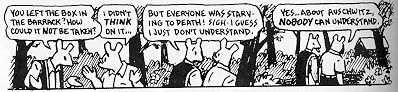
"Maus was based on the experiences of his parents as concentration camp survivors. It became a graphic novel which portrayed the Jews as mice and the Germans as cats (the Katzies.) His fathers memories and Art's own account complement each other by portraying the lives and struggles of a econd generation of Jewish people whose existences are influenced by the Holocaust, even thought they were not born at the time. The trait separates "Maus" from other Holocaust narratives by offering another side to the story. His Father's final commentary on the strip, " Nobody can understand" shows how difficult is it for the next generation but also for the survivors themselves.


Part of a strip from "Maus"

Saturday, December 02, 2006

Chris Ware is an American comic book artist and cartoonist. He is best-known for a series of comics called the "Acme Novelty Library" and the graphic novel, "Jimmy Corrigan, the Smartest Kid on Earth."
His art has many influences and largely reflects his love of early twentieth century aesthetics. His designs transition through many artistic styles from traditional comic bok panels to advertisements and even toys. His precise, geometric layouts appear to be computer generated but in fact he works almost always with drawing tools such as pencil and paper. Sometimes he uses the computer for colour strips and also uses photocopies and transparencies.

He works by learning from artists he admires and who he thought came the closes to getting the "essence" of comics, which is really the process of reading pictures, not just looking at them. He sees the black outline of cartoons as "visual approximations of the way we remember general ideas" and trys to use naturalistic colour underneath to "simultaneously suggest a perceptual experience" which he believes is more or less the way we experience the world as adults.

Chris Ware has developed a language of simple graphics focusing on timelessly simple life experiences and transforming them into "profound and understandable declarations about the human condition." His uniquely appealing work is characterized by ceaseless experimentation with narrative and graphic forms.

His graphic novel "Jimmy Corrigan; The Smartest kid on Earth" started in a strip Ware was writing for the Chicago tabloid "New City." He combined six years of these strips and produced this best selling graphic novel. The novel gained numerous awards for its experiments in graphics such as non-chronological narratives, pull-outs and 3D inserts.


A scene from Jimmy Corrigan; the
Smartest Kid on Earth


I like the way Ware constantly changes and experiments with his narrative techniques. I have been experimenting with such techniques and it it helping me to construct a better storyboard.

Friday, December 01, 2006

Pablo Ferro is a graphic designer and film titles designer. He is best known for his quick-cut editing and using multiple images within one frame, helping to create a an influential visual style which has enriched film, animation and commercials. He has worked with high-tech and optical techniques. His trademark hand-drawn lettering is another technique, one which had an obvious influence on Kyle Cooper. He has an innovative way of making collages and using abstract oimagery to consistently challenge the medium, whilst also altering perceptions of how information is received by viewers.
His technalogically inventive visual presentations include the Singer Pavilion's film at the 1964 New York World's fair. This was the first time film projecters were used to create multiple-screen images.
He has also created memorable trailers for films such as A Clockwork Orange.
His most famous work is probably the opening sequence to Stanley Kubrick's Dr Strangleove and the revolutionary split-screen montage of the original "Thomas Crown Affair."


A shot from the intro sequence
to the "Thomas Crown Affair"


I had not heard of Pablo Ferro before this project but can see where he has directly influenced Kyle Cooper. I like his innovative ways and how ahead of their time they were when they were made.

Sunday, November 19, 2006

Kyle Cooper is a designer of motion picture title sequences. He most often takes a two-hour film and consolidates it into two minutes, providing an overview, foreshadowing or at least setting the emotional tone. Other times he can participate in the creation of an entirely new scene, which serves as the first act of the film. The main purpose of the title sequences are to create the mood and prepare the audience for what is ahead. Great title sequences are symbolic and thoughtful, they embrace the story and help to clairify the plot or set up the personality of the main character/s.
Cooper's works include the title sequence for Se7en (1995), The Mummy (1999), Spider-man (2002), Dawn of the Dead (2004) and video game Metal Gear Solid 3 (2004).

One of his most well known works is the title sequence for Donnie Brasco. In this he reveals the nature of the main character. To come up with the sequence Cooper accessed surveillence-type photography used for the film and then experimented with fonts. The result was a stylish title design that introduced us to the characters whilst at the same time establishing Johnny Depp's outsider status before the movie even begins.

Clip from the title sequence of
Donnie Brasco


For Coooper's work on the film Se7en, the director wanted to set up the films relationship with evil in a very direct and uncomfortable way. It takes so long for the killer to be revealed in the film that they wanted to foreshow his macabre movements from the very beginning of the movie. The title sequence references the killers fussy preparations for murder.


Clip from the title sequence
for Se7en


I am a big fan of Cooper's work. I like the way he takes influences from Pablo Ferro by using hand-drawn lettering on some of his work. I really liked the intro sequence to Se7en.
I'm experimenting with hand-drawn lettering in my work as I don't like the restrictions of computerised fonts.

Gregory Crewdson is an American photographer best known for his elaborately staged, surreal scenes of American houses and neighbourhoods. He explores sterotypes about making art and his photos concentrate on a tension between nature and domesticity.
Crewson is one a leader in the practising of using staged events and constructed models in photographic art, blurring the distinction between fiction and reality. He focuses on suburban ladnscapes, carefully composing each photo with dramatic lighting.
His influences include his father, documentary photography and classic cinematic devices used in science fiction and horror films.
Crewdson mixes traditional documentary photographic styles with fictional elemnets. By using this technique the artist is no longer passively experiencing the world and then editing it. He is now an active individual creating his own world then photographing it.

"Twighlight" is a series of images made between 1998 and 2002. The whole series was shot at dusk when the light of nature merges with the artificial light of humans. The images are unsettling with an eerie sense of stillness.
One example was shot on a constructed stage where a boy in his underwear can be seen reaching into a bathroom drain. The dark, empty space below the floor and the dramatic lighting coming through the window turn what appears to be a mundane scene into something unexplicalbe in an unknown narrative.


Example from the "Twilight"
series.


In another series entitled "Hover" he moved out of his studio to photograph suburban scenes from a bird's eye view. The photos represent American life gone awry (a man mowing circular patterns in his lawn.)

I like the surrealness of Crewdson's photographs. Like Wall, his work is not often how it first appears and there is a sense of mystery to his work.

Friday, November 17, 2006

Jeff Wall is a Canadian photographer who's pieces veer towards narrative and classical often alluding to historical artists. He was born, lives and works in Vancouver and has been a key figure in the vibrant art scene of the city for many years. Wall's themes are mainly social and political, including issues such as racism, violence, poverty and gender. He distinguishes between unstaged "documentary" pictures and "cinematographic" pictures (in which he uses a number of actors, sets and special effects to produce.)

Wall's techniques are to produce large scale photographs displayed on light boxes in which the narratives are meticulously created using actors, lighting and digital manipulation.

"Mimic" (1982) shows his cinematographic style. It is a large colour transparency showing a white couple and an asian man walking towards the camera. The sidewalk is filled with cars and residential and industrial buildings, suggesting a North American suburb. The woman is wearing red shorts and a short top showing her belly. Her boyfriend is in a denim vest with a scruffy beard. The man is more formally dressed. As they pass the boyfriend makes an obscene gesture towards the man, one the girlfriend cannot see. This camptures the moment and the social tensions that are implied within it, but is also a recreation of an exchange witnessed by the artist.


"Mimic" (1982)


Wall also became interested in film stills and much of his work has stemmed from this. The interest was more in the narritve of the stills. An example of this is "Insomnia" (1994) depicts a man wearing what appear to be pyjamas, lying on the floor in a kitchen underneath the table. The man is in his own world, seemingly unaware that he is being photographed. This technique brings in the element of narrative, enticing us to imagine why the man is lying on the floor in such harsh lighting.
"Insomnia" (1994)
I like the way we are forced to look a little closer at Wall's photographs. At first glance they may appear to be one thing but are actually something completely different.

Edward Hopper is an American realist artist whos work was often quite private and who made introspection and solitude important themes in his painting.
His subject matter was derived from common features in American life. These included motels, gas stations, railways and even empty streets.
Hopper depicts ruraly scenes with the same sense of forlorn solitude that he uses to portray city life. His work exploits vast empty spaces which could be represented by a lonely gas station at the side of an empty country road, also emphasising the sharp contrast between the natural light of the sky and the artificial light which glares from inside the gas station.

In 1925 Hopper produced "House by the Railroad." This is the first in his series of stark urban and rural scenes that use sharp lines and big shapes, with unusual lighting cast upon them to capture the lonely mood.


"House by the Railroad" (1925)


One of his best known paintings is called "Nighthawks" (1942) This depicts customers sitting at the counter of an all night diner. The gentle night outside is a stark contrast to the diner's harsh electric light. The diners appear completely isolated and almost scary looking.


"Nighthawks" (1942)


Hopper's dramatic use of lights and darks has made him popular with filmakers. "House by the Railroad" is said to have been an influence on the house in the film "Psycho" by Alfred Hitchcock.

I think the use of lighting and the theme of isolation work really well together. You can definately see the influence in "Psycho."

Cindy Sherman is one of the most influential and respected photographers of the late twentieth century. Her photographs are pictures of her, but are in no way self portraits. She uses herself as a vehicle to comment on a variety of issues in the modern world. These include issues such as the role of a woman and the role of an artist etc. It is through these photographs filled with ambiguoty that Sherman has developed her own distinct style. She has raised important and challenging questions about how women are represented in society and the nature and creation of art.
Sherman works in series, photographing herself in a range of costumes.
Perhaps her most well-known series is "Untitled Film Stills" which she began in 1977. Sherman places herself in the roles of B-Movie actresses, wearing different clothes, wigs and accessories. In each photo she plays a "type" and not an actual person. There is the typical housewife, prostitute, dancer, actress etc. By giving each photo the title "Untitled" she is depersonalizing the images.


Images from
"Untitled
Film
Stills"


Towards the end of the 80's Sherman released "History Portraits." Again she used herself as the model but she cast herself in roles from famous paintings. Very few of these paintings are actually referenced. She uses prosthetic body parts and recreates great pieces of art, manipulating her role as a contemporary artist in the late twentieth century.
I am a big fan of Sherman's work. Each character looks nothing like her but yet it is. I like the way she really becomes the person she is depicting.