Friday, December 08, 2006

Nan Goldin is an American artist and photographer. Her work is often presented in the form of a slideshow. Most famous is a 45 minute show in which 800 pictures are displayed.


Front cover of a book
of photos "The Ballad
of Sexual Dependency."


Nan Goldin's photographs are intimate and compelling - they tell personal stories of relationships, friendships and identity, but at the same time show different eras and the passage of time. Themes range from drag queens and AIDS to the family and maternity. In her book "Devil's Playground" thoe photographs are laid out in chronological sequences like a diary.

"Nan one month after
being battered" -(1984)


She often uses herself in her narrative, like Cindy Sherman and Claude Cahun.

Saul bass was a graphic designer but was best known for his movie title sequences. He did work for many directors such as Alfred Hitchcock, Martin Scorsese and Stanley Kubrick. His most famous title sequence is for Otto Preminger's "The Man with the Golden Arm," which involved the animated paper cut-out of a heroin addict's arm. In his later work for Scorsese he moved away from the optical techniques that he had pioneered and moved into computerised titles, from which he produced the title sequence for "Casino."


Poster for the film "The
Man with the Golden arm."


Saul's opening for "West Side Story" is a solid block of color that morphs according to the overture. In other title sequences he employs hand-drawn type and cutout construction paper shapes.

"Bass’ techniques are various and decidedly inconsistent: cutout animation, montage, live action, and type design to name only his more prominent exercises. Secondly, Bass exhibits an exemplary use of color and movement. Often sequences begin with a solid, empty frame of color (as with Exodus’ blue or North by Northwest’s green). His design tactic in this context, although characteristic, possesses subtly and variety." - (Rumsey Taylor.)

Charles Burns is an American cartoonist and illustrator. He is most famous for his high-contrast and creepy artwork and stories. His earlier work included contributions to Art Spiegelman's comic magazine entitled "Raw." His work concentrates on the tensions between innocence and evil. His work combines fresh looking lines with issuses such as horror and sex.


A strip from "Black Hole"
I noticed the use of different
narrative techniques.


Beneath theses images of horror and other themes lurk the real traumas of childhood, traumas of loss and alienation. Dreams and symbols play a major role the development of character and theme.

Burns's work posesses a graphic style that is instantly recogniseable.


Thursday, December 07, 2006

Claude Cahun was a French Photographer and writer. Her work was personal and political and, like Cindy Sherman's, often played with the concepts of gender and sexuality. She experimented with her audience's understanding of photography as a documentation of reality. Her thought-provoking self-portraits often involved costumes or masks as a way of exploring her identity.


"Self- Portrait (Double exposure
in rock pool)" 1928


Cahun's work was far more personal than Sherman's. Like much of her life it questioned ideas of gender and sexuality. She used various disguises, as well as shaving and colouring her hair to challenge and dissolve the boundaries and common sterotypes. Cahun does not limit herself to female stereotypes, but also plays out male roles, and confronts the camera boldly, with a defiant look rather than the submissive one that is in much of Sherman's work.

Sunday, December 03, 2006

One thing that connects all the mentioned artists below is their experimental use of narrative. The narrative is important in all their work and often defines their piece. They each focus on important themes and issues in the world and express their views in often quite dramatic ways. Cindy Sherman and Jeff Wall both focus on issues in society such as social perceptions and gender. Edward Hopper and Gregory Crewdson both focus on American landscapes and the contrasts between nature and domesticity. Kyle Cooper and Pablo Ferro both show direct links with each other in their style of working.

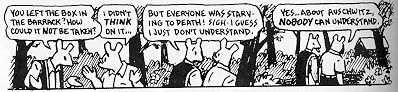
Art Spiegelman is an American comic book artist and his best known for his comic memoir "Maus." He beleives that comics are a narrative art form that combines two other forms of expression: words and pictures. He commits his thoughts and emotions to a written narrative.

"Maus was based on the experiences of his parents as concentration camp survivors. It became a graphic novel which portrayed the Jews as mice and the Germans as cats (the Katzies.) His fathers memories and Art's own account complement each other by portraying the lives and struggles of a econd generation of Jewish people whose existences are influenced by the Holocaust, even thought they were not born at the time. The trait separates "Maus" from other Holocaust narratives by offering another side to the story. His Father's final commentary on the strip, " Nobody can understand" shows how difficult is it for the next generation but also for the survivors themselves.


Part of a strip from "Maus"

Saturday, December 02, 2006

Chris Ware is an American comic book artist and cartoonist. He is best-known for a series of comics called the "Acme Novelty Library" and the graphic novel, "Jimmy Corrigan, the Smartest Kid on Earth."
His art has many influences and largely reflects his love of early twentieth century aesthetics. His designs transition through many artistic styles from traditional comic bok panels to advertisements and even toys. His precise, geometric layouts appear to be computer generated but in fact he works almost always with drawing tools such as pencil and paper. Sometimes he uses the computer for colour strips and also uses photocopies and transparencies.

He works by learning from artists he admires and who he thought came the closes to getting the "essence" of comics, which is really the process of reading pictures, not just looking at them. He sees the black outline of cartoons as "visual approximations of the way we remember general ideas" and trys to use naturalistic colour underneath to "simultaneously suggest a perceptual experience" which he believes is more or less the way we experience the world as adults.

Chris Ware has developed a language of simple graphics focusing on timelessly simple life experiences and transforming them into "profound and understandable declarations about the human condition." His uniquely appealing work is characterized by ceaseless experimentation with narrative and graphic forms.

His graphic novel "Jimmy Corrigan; The Smartest kid on Earth" started in a strip Ware was writing for the Chicago tabloid "New City." He combined six years of these strips and produced this best selling graphic novel. The novel gained numerous awards for its experiments in graphics such as non-chronological narratives, pull-outs and 3D inserts.


A scene from Jimmy Corrigan; the
Smartest Kid on Earth


I like the way Ware constantly changes and experiments with his narrative techniques. I have been experimenting with such techniques and it it helping me to construct a better storyboard.

Friday, December 01, 2006

Pablo Ferro is a graphic designer and film titles designer. He is best known for his quick-cut editing and using multiple images within one frame, helping to create a an influential visual style which has enriched film, animation and commercials. He has worked with high-tech and optical techniques. His trademark hand-drawn lettering is another technique, one which had an obvious influence on Kyle Cooper. He has an innovative way of making collages and using abstract oimagery to consistently challenge the medium, whilst also altering perceptions of how information is received by viewers.
His technalogically inventive visual presentations include the Singer Pavilion's film at the 1964 New York World's fair. This was the first time film projecters were used to create multiple-screen images.
He has also created memorable trailers for films such as A Clockwork Orange.
His most famous work is probably the opening sequence to Stanley Kubrick's Dr Strangleove and the revolutionary split-screen montage of the original "Thomas Crown Affair."


A shot from the intro sequence
to the "Thomas Crown Affair"


I had not heard of Pablo Ferro before this project but can see where he has directly influenced Kyle Cooper. I like his innovative ways and how ahead of their time they were when they were made.